
Rituals at Muzdalifah
- Home
- Islamic Blogs
- Muzdalifah
The Arabic word “Izdalafa,” which meaning “to approach” or “to come near,” is the source of the name Muzdalifah. The Quran mentions al-Mashar al-Haram, another name for muzdalifah

This verse highlights how important it is to remember and give thanks to Allah (SWT) while on pilgrimage, particularly at muzdalifah, where spiritual rejuvenation is desired.
See the following blog post for additional details on comprehending the Hajj and its historical significance: FIVE PILLARS OF ISLAM
A major destination on the Hajj pilgrimage, muzdalifah is where travelers spend the night outside after leaving Arafat. With the help of this thorough book, you will gain a thorough understanding of Muzdalifah, its significance, and the rites followed at this hallowed location. This guide will provide you a comprehensive understanding of what the overnight stay at Muzdalifah comprises and how to properly observe it.
Between Arafat and Mina lies an open plain called Muzdalifah. After departing Arafat on the ninth day of Dhul-Hijjah, pilgrims spend the night there. An essential component of the Hajj journey is spending the night in muzdalifah.

Muzdalifa is a necessary stop during Hajj, where pilgrims spend the night under the open sky, following the way of Prophet Muhammad (PBUH).
Staying in Muzdalifa gives pilgrims a chance to remember Allah, pray, and feel closer to Him.
Pilgrims collect pebbles here for the stoning ritual (Rami) in Mina and prepare for the next steps of Hajj.
Muzdalifa is a special place where Prophet Ibrahim (AS) and Prophet Muhammad (PBUH) performed Hajj, making it a place of great respect and honor.
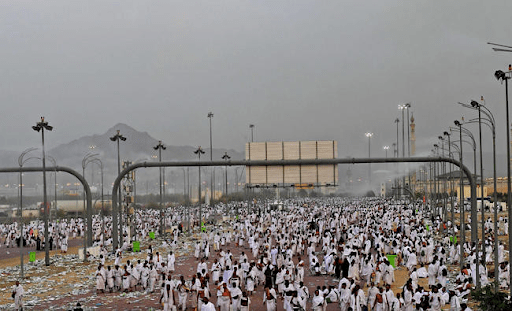
After sunset on the Day of Arafat, pilgrims begin their peaceful journey to Muzdalifa. They travel either by walking or by bus, reflecting on the spiritual moments of the day.
The distance between Arafat and Muzdalifah Hajj depends on the route and transport. By train, it is about 10 kilometers, while by road, it increases to around 17 kilometers. A car ride usually takes 15 minutes, but during Hajj, traffic can make the journey longer.
Since thousands of pilgrims travel at the same time, patience is important. Avoid rushing or pushing, as everyone is on the same spiritual journey. Reciting Dhikr (remembrance of Allah) and making Duas can help keep the mind focused.
Moving from Arafat to Muzdalifah is a special step in Hajj, marking the transition from reflection to preparation for the next stages.
When worshippers arrive during Muzdalifah in Hajj pilgrimage, they engage in a special custom called “combining salahs at Muzdalifah.” The Maghrib and Isha prayers, which are offered during Isha as Qasr, are combined and simplified in this ritual. One Adhan, Iqama, and three rak’ahs for Maghrib are the first steps of the process. Following the recitation of Takbir al-Tashreeq, worshipers offer two rak’ahs for Isha, which are followed by Talbiyah and another Takbir al-Tashreeq. During the Hajj trip, this simplified style of worship helps to accommodate big audiences.
For a complete guide on the steps of Hajj and its importance in Islam, visit:
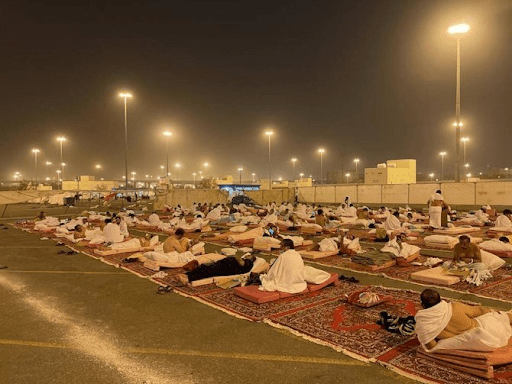
An essential component of the Hajj trip is staying overnight in Muzdalifah in Hajj. Sleeping under the open sky is a powerful moment of humility and equality for pilgrims. As everyone lies side by side on the earth, the experience erases worldly differences. As millions of people gather in the same area for silent prayer and reflection, the atmosphere is infused with a profound sense of serenity and community spirituality.
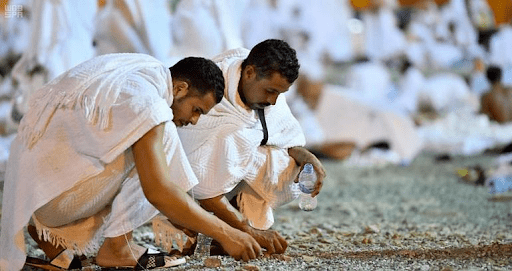
Gathering stones in Muzdalifah in Hajj is one of the beginnings to the last Hajj ritual, known as Rami al-Jamarat. In order to represent stoning the demon, stones are thrown at three pillars. The act represents rejecting evil and refusing desire.
You shall execute Rami (the stoning of the demon) on the tenth, eleventh, and twelfth days of Dhul Hijjah. The pebbles should be around the same size as seeds or date stones. A total of 49 pebbles will be required.
For each of the three days, a specific quantity of pebbles will be required.
On the 10th of Dhul Hijjah, pilgrims throw seven pebbles at Jamarat al-Aqaba.
On the 11th of Dhul Hijjah, a total of 21 pebbles are thrown—seven at each of the three Jamarat.
On the 12th of Dhul Hijjah, pilgrims repeat the ritual by throwing 21 pebbles at the three Jamarat.
It’s crucial to keep to the rules about the quantity of stones needed. Every day, seven stones are placed in each of the three Jamarat, for a daily total of twenty-one pebbles. This is to guarantee that there are additional stones in case some are dropped during the ritual or miss the target.
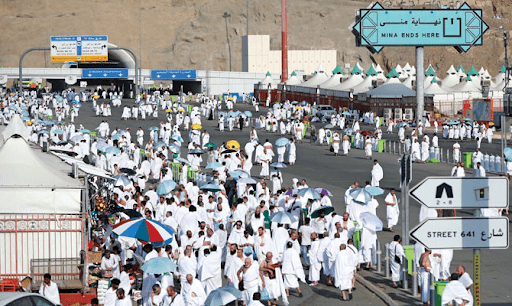
For a detailed step-by-step guide on performing Hajj, visit 👉 How to Perform Hajj Step by Step.
The rituals of Muzdalifah Hajj hold deep spiritual and historical significance in Hajj. Spending the night under the open sky, offering Fajr prayer, and collecting pebbles for the Rami ritual are essential acts of devotion. This sacred stop allows pilgrims to reflect, seek Allah’s mercy, and prepare for the next steps of their journey. By following these practices, pilgrims strengthen their faith and fulfill an important part of the blessed pilgrimage.