
The Complete History of Makkah — Islam's Holiest City
- Home
- Makkah Ziyarat
- History Of Makkah
Makkah — known in English as Mecca — is the holiest city in Islam and one of the most significant cities in human history. Located in the Hejaz region of western Saudi Arabia, approximately 70 km inland from Jeddah, it sits in a narrow valley at 277 metres above sea level, surrounded by the Sirat Mountains. For over four thousand years, this valley has been the spiritual heartbeat of the world’s Muslim population — a place where history, faith, and devotion converge.
Every year, millions of pilgrims from the United Kingdom, the United States, Pakistan, and every corner of the world travel to Makkah to perform Hajj and Umrah. To truly appreciate the significance of this journey, it helps to understand the extraordinary history of the city you are entering.
This guide covers the complete history of Makkah — from its ancient origins and pre-Islamic era, through the birth of the Prophet Muhammad (SAW), the Hijrah, and the Conquest of Makkah, to the modern expansions that have made it capable of welcoming millions of pilgrims today.
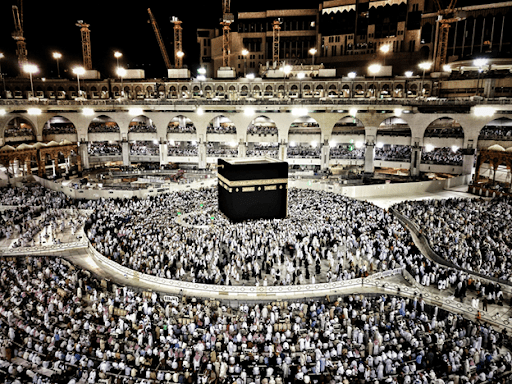
Long before Islam, the valley of Makkah was known as Bakkah. The site is believed to have been inhabited since ancient times, positioned along important caravan trade routes connecting the Arabian Peninsula to the Mediterranean Sea and the Indian Ocean. These routes made it a natural gathering point for traders and travellers, giving the settlement early commercial significance even before its religious importance was established.
The ancient historian Ptolemy, writing in the 2nd century CE, referenced a city called “Macoraba” in the Arabian Peninsula, which many scholars have identified as Makkah. The name is thought to combine the word “Makkah” with the Aramaic word “rabb,” meaning great — suggesting the city was already considered significant in the ancient world.
According to Islamic tradition, the history of Makkah as a sacred city begins with Prophet Ibrahim (Abraham, peace be upon him), one of the most revered prophets in Islam. Acting on Allah’s (SWT) command, Ibrahim (AS) brought his wife Hajar (Hagar) and their infant son Ismail (Ishmael) from Hebron — in present-day Palestine — to this remote, barren valley, and left them there with a small supply of water and dates, trusting in Allah’s provision.
When their water ran out, Hajar searched desperately for help. She ran seven times between the two small hills of Safa and Marwa, seeking water or a passing caravan. On the seventh run, she heard a sound. The Angel Jibreel (Gabriel) struck the ground, and from the earth sprang a miraculous source of fresh water — the well of Zamzam. This spring still flows beneath Masjid al-Haram to this day, and the ritual running between Safa and Marwa (known as Sa’i) is a cornerstone of both Hajj and Umrah.
The flowing water of Zamzam attracted the Jurhum tribe of Yemen, who settled near the site. Makkah began to grow from a barren valley into a permanent settlement. Ismail (AS) grew up among the Jurhum tribe and later married into it, becoming the ancestor of the Adnanite Arabs from whom Prophet Muhammad (SAW) would descend centuries later.
The most pivotal event in the founding of Makkah as a holy site was the construction of the Kaaba. When Ismail (AS) had grown into a young man, his father Ibrahim (AS) returned to Makkah, and together — father and son — they built the Kaaba upon Allah’s command, on the site believed to have first been marked by Prophet Adam (AS).
The Kaaba is a cube-shaped structure located at the centre of Masjid al-Haram. The word “Kaaba” means “cube” in Arabic, which reflects its shape. The structure stands approximately 15 metres (50 feet) high, with a base measuring roughly 10 by 12 metres (35 by 40 feet). It is built from grey stone and marble, with its four corners broadly aligned to the cardinal directions.
Inside the Kaaba stand three pillars supporting the roof, along with suspended lamps of silver and gold. For most of the year, the exterior is draped in the Kiswah — a large black cloth embroidered with verses from the Quran in gold thread. The Kiswah is replaced annually, and sections of the old cloth are distributed to dignitaries and institutions around the world.
Built into the eastern corner of the Kaaba is the Hajar al-Aswad — the Black Stone. Muslims believe it descended from paradise and was originally white, darkening over centuries from the sins of mankind. Pilgrims attempt to kiss or touch the Black Stone during Tawaf (circumambulation of the Kaaba), following the tradition of the Prophet Muhammad (SAW).
When Ibrahim (AS) completed the Kaaba, he called out — by Allah’s command — for all people to come and perform pilgrimage. The annual Hajj pilgrimage to Makkah traces its origins directly to this call, an act that has echoed across more than four thousand years of human history.
Over the centuries following Ibrahim (AS) and Ismail (AS), Makkah grew in significance as a centre of both trade and pilgrimage. However, over time, the pure monotheism they had established gave way to polytheism. Various Arabian tribes introduced idols into the Kaaba, and by the time of the Prophet Muhammad (SAW), the structure housed over 360 idols representing the deities of different Arab tribes.
Despite this religious corruption, the Kaaba remained a pilgrimage site, and Makkah remained a prosperous trading city. The Quraysh tribe — descended from Ismail (AS) through the Adnan line — became the guardians of the Kaaba and the dominant tribe of Makkah. This custodianship brought them enormous political and economic power, as pilgrims travelling to Makkah provided a major source of income for the city.
The pre-Islamic era in Makkah is known in Arabic as the Jahiliyyah, meaning the “Age of Ignorance” — a period characterised by tribal rivalries, the burying of infant daughters, and the worship of idols. It was into this society that the Prophet Muhammad (SAW) was born.
The Prophet Muhammad (SAW) was born in Makkah on the 12th of Rabi al-Awwal, 570 CE — a year known as the Year of the Elephant, so called because that year the Yemeni ruler Abraha attempted to demolish the Kaaba with war elephants, and was miraculously repelled. Muhammad (SAW) was born into the Quraysh tribe, specifically the Banu Hashim clan, one of Makkah’s most respected families.
His father Abdullah had died before his birth, and his mother Aminah died when he was six years old. He was raised first by his grandfather Abdul Muttalib, and after his grandfather’s death, by his uncle Abu Talib. As a young man, Muhammad (SAW) was known throughout Makkah for his honesty and trustworthiness, earning him the title Al-Amin — “the Trustworthy.”
At the age of 25, he married Khadijah (RA), a respected businesswoman 15 years his senior, who had employed him to manage her trade caravans. Their marriage was one of deep love, respect, and partnership, and Khadijah (RA) would become the first Muslim.
When Muhammad (SAW) was 40 years old, he retreated — as was his habit — to the Cave of Hira on Jabal al-Nour (Mountain of Light), just north of Makkah. It was here, in 610 CE, that he received the first revelation of the Quran from Angel Jibreel (AS). The first words revealed were “Iqra” — meaning “Read” or “Recite” — the opening verses of Surah Al-Alaq.
This moment marked the beginning of Islam as a religion and the start of Muhammad’s (SAW) 23-year prophethood. Pilgrims visiting Makkah today can still visit the Cave of Hira — it remains one of the most visited sites in the city, a short but steep climb from the base of Jabal al-Nour.
The Prophet Muhammad (SAW) began preaching the message of monotheism in Makkah. The response from the Quraysh leadership was overwhelmingly hostile. Accepting Islam meant rejecting the 360 idols of the Kaaba — a direct economic and political threat to the Quraysh, whose wealth and power rested on their role as custodians of the pilgrimage site.
The early Muslims faced severe persecution. Enslaved Muslims were tortured in the desert heat. Others were economically boycotted, with the Banu Hashim clan placed under a social and commercial embargo for three years. Many Muslims sought refuge in Abyssinia (present-day Ethiopia), where the Christian king Negus (Ashama ibn Abjar) granted them protection.
Despite the hardship, the Muslim community grew. Key early converts included Khadijah (RA), Ali ibn Abi Talib (RA), Abu Bakr al-Siddiq (RA), and Uthman ibn Affan (RA) — names that would go on to shape the first decades of Islamic civilisation.
By 622 CE, the situation in Makkah had become untenable. The Quraysh plotted to assassinate the Prophet Muhammad (SAW). In response to a divine command, the Prophet (SAW) and his closest companion Abu Bakr (RA) made a secret night-time departure from Makkah, heading north to the city of Yathrib — later renamed Madinah al-Munawwarah, the City of Light.
This migration is called the Hijrah, and it is so significant in Islamic history that it marks the beginning of the Islamic (Hijri) calendar — the year of the Hijrah is year one of the Muslim calendar. The Hijrah was not a defeat. It was a strategic and divinely guided transition that allowed Islam to establish a political and social framework. Within a decade, this foundation would be strong enough for the Prophet (SAW) to return to Makkah — not as a refugee, but as its liberator.
In 630 CE, eight years after the Hijrah, the Prophet Muhammad (SAW) led an army of 10,000 Muslims back to Makkah — an event known as Fatah Makkah, the Conquest (or Opening) of Makkah. The Quraysh, whose forces were vastly outnumbered and whose alliances had collapsed, offered no meaningful resistance. The city was taken with almost no bloodshed.
The Prophet Muhammad (SAW) entered Makkah humbly, his head bowed, reciting verses of gratitude to Allah (SWT). He proceeded directly to the Kaaba, circumambulated it seven times, and then commanded the destruction of all 360 idols inside and surrounding it, restoring the Kaaba to the monotheistic sanctuary that Ibrahim (AS) had originally built.
In an act of extraordinary generosity, the Prophet (SAW) announced a general amnesty for the people of Makkah, including those who had most violently persecuted the early Muslims. He is reported to have said: “Go, for you are free.” This moment is celebrated in Islamic history as an example of mercy triumphing over vengeance.
After the Conquest of Makkah, Islam spread rapidly across the Arabian Peninsula. The Prophet Muhammad (SAW) passed away in 632 CE in Madinah, having completed his final pilgrimage to Makkah — the Farewell Hajj — just months before his death.
Following the Prophet’s (SAW) death, Makkah remained under the administration of the expanding Islamic state. The successive Caliphates — Rashidun, Umayyad, Abbasid, and Ottoman — all recognised Makkah’s supreme spiritual status and invested in its development.
The Masjid al-Haram was expanded multiple times across this period. The Umayyad Caliph Abdullah ibn al-Zubayr reconstructed the Kaaba itself in 684 CE, incorporating the hijr Ismail — the semicircular wall adjacent to the Kaaba — within its structure. The Abbasid Caliphs significantly extended the mosque in the 8th and 9th centuries, adding minarets and covered galleries to accommodate the growing number of pilgrims.
During the Abbasid era, Makkah also became a major centre of Islamic scholarship. Scholars from across the Muslim world gathered there, and the annual Hajj served as a kind of global Muslim conference — a meeting of minds, cultures, and traditions from Spain to China.
The Ottoman Empire took control of Makkah in 1517 under Sultan Selim I, following the defeat of the Mamluk Sultanate of Egypt. Makkah remained part of the Ottoman Empire for over four centuries, until the empire’s collapse after World War I.
The Ottomans were devoted custodians of the Two Holy Mosques. Ottoman sultans undertook major renovation projects at Masjid al-Haram and invested heavily in the infrastructure of Makkah and Madinah. The Hejaz Railway, built between 1900 and 1908, connected Damascus to Madinah and was intended to eventually extend to Makkah, dramatically easing the journey for pilgrims.
In 1924, following the collapse of the Ottoman Empire, the forces of Abdul-Aziz ibn Saud (Ibn Saud) took control of Makkah, incorporating the Hejaz region into what would become the Kingdom of Saudi Arabia in 1932. Since then, the Saudi government — holding the title “Custodians of the Two Holy Mosques” — has overseen the most dramatic expansion and modernisation in Makkah’s history.
The Grand Mosque of Makkah, Masjid al-Haram, is the largest mosque in the world and the holiest site in Islam. In the early 20th century, it could accommodate approximately 50,000 worshippers. Today, following decades of Saudi-funded expansion projects, it can hold over 2 million pilgrims during Hajj season.
Major expansion phases took place in the 1950s, 1980s, and 2000s, with ongoing projects continuing today. The King Abdulaziz Expansion, which began in the 1980s, more than doubled the mosque’s capacity. The ongoing Saudi Bin Laden Group constructions have added vast air-conditioned halls, escalators, and multi-storey capacity to handle the growing global Muslim population.
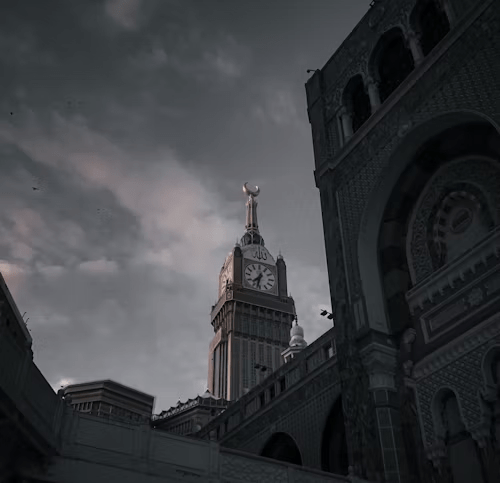
One of the most recognisable features of modern Makkah is the Abraj al-Bait complex — a group of seven skyscrapers dominated by the Makkah Royal Clock Tower, one of the tallest buildings in the world. The Clock Tower stands at 601 metres, making it visible from virtually anywhere in the city. The complex, completed in 2012, houses hotels, residences, and a shopping mall, and is positioned directly opposite the Masjid al-Haram to serve the millions of pilgrims who stay in the area.
The development has been controversial among historians and heritage advocates, as it required the demolition of the historic Ajyad Ottoman Fortress and other structures of significant historical value. The debate between modernisation and heritage preservation remains one of Makkah’s most sensitive ongoing issues.
Today, approximately 2 to 3 million pilgrims perform Hajj in Makkah each year, with Umrah attracting an additional 13 to 15 million visitors annually — a number the Saudi government aims to increase to 30 million by 2030 as part of its Vision 2030 programme.
The logistics of serving this many people are extraordinary. The Masha’er Railway (Haramain Metro) connects the key Hajj sites of Arafat, Muzdalifah, and Mina during the Hajj season. The King Abdulaziz International Airport in Jeddah handles tens of millions of pilgrims each year, with a dedicated Hajj terminal — one of the largest airport terminals in the world — built specifically for the annual pilgrimage.
For pilgrims performing Hajj or Umrah, Makkah is home to several sites of immense spiritual significance. Below are the most important locations you will visit or pass through during your journey.
Masjid al-Haram — The Grand Mosque, home to the Kaaba. The focal point of both Hajj and Umrah; all Tawaf is performed here.
The Kaaba — The House of Allah (SWT), the direction of prayer for all Muslims worldwide, and the site of the ritual of Tawaf.
Hajar al-Aswad — The Black Stone, set into the eastern corner of the Kaaba. Pilgrims attempt to kiss or gesture towards it during Tawaf.
Zamzam Well — Located beneath Masjid al-Haram, it has provided water continuously since the time of Hajar (AS). Pilgrims drink Zamzam water freely inside the mosque.
Safa and Marwa — The two hills between which Hajar (AS) ran in search of water. The ritual of Sa’i — running or walking between these hills seven times — is performed during both Hajj and Umrah.
Jabal al-Nour (Mountain of Light) — The hill containing the Cave of Hira, where the Prophet Muhammad (SAW) received the first Quranic revelation.
Jabal Thawr — The cave in this mountain provided shelter for the Prophet (SAW) and Abu Bakr (RA) during the Hijrah. A site of deep spiritual resonance for pilgrims.
Mina — The tent city east of Makkah where pilgrims spend nights during Hajj and perform the stoning of the Jamarat (the symbolic stoning of the devil).
Arafat (Mount Arafah) — The plain outside Makkah where pilgrims gather on the 9th of Dhul Hijjah — the day of Wuquf (standing). This is considered the pinnacle of Hajj.
Muzdalifah — Where pilgrims collect pebbles for the Jamarat stoning and spend the night under the open sky between Arafat and Mina.
For pilgrims arriving from the United Kingdom or the United States, the journey to Makkah typically begins at King Abdulaziz International Airport (KAIA) in Jeddah — approximately 80 km from the holy city. The road journey from Jeddah Airport to Makkah takes 60 to 90 minutes depending on traffic, which can be significant during peak Umrah and Hajj periods.
At Makkah2Madinah, we specialise in private Umrah taxi transfers for UK and US pilgrims throughout Saudi Arabia. Our services cover every route you will need during your Umrah:
We offer a range of vehicles from private sedans (Hyundai Sonata) to coaches, covering groups of any size. All bookings include a meet-and-greet service and can be arranged via WhatsApp within minutes.
Get a quote for your Umrah transport →
Why is Makkah the holiest city in Islam?
Makkah is the holiest city in Islam for several reasons: it is the birthplace of the Prophet Muhammad (SAW), the site of the Kaaba — the house of Allah (SWT) built by Prophet Ibrahim (AS) and Ismail (AS) — and the destination of the annual Hajj pilgrimage, which is one of the Five Pillars of Islam. Facing the Kaaba in Makkah (the Qibla) is also required for every Muslim’s daily prayers.
Who built the Kaaba in Makkah?
According to Islamic tradition, the Kaaba was originally built by Prophet Adam (AS) and later rebuilt by Prophet Ibrahim (AS) and his son Ismail (AS) upon Allah’s command. It has been renovated and reconstructed multiple times throughout history, including during the time of the Prophet Muhammad (SAW) after a flood damaged it, and again by Abdullah ibn al-Zubayr in 684 CE.
Can non-Muslims visit Makkah?
No. Makkah is restricted to Muslims only. Road signs on the approaches to the city direct non-Muslims to alternative routes that bypass the city. This restriction has been in place since the time of the Prophet Muhammad (SAW) and is enforced by the Saudi government.
What is the Zamzam Well?
The Zamzam Well is a sacred spring located within Masjid al-Haram, approximately 20 metres from the Kaaba. According to Islamic tradition, it sprang miraculously when the Angel Jibreel (AS) struck the ground to provide water for Hajar (AS) and the infant Ismail (AS). The well has flowed continuously for over 4,000 years and is one of the most significant sites in Makkah for pilgrims.
What is the difference between Hajj and Umrah?
Hajj is the major pilgrimage to Makkah, performed during the month of Dhul Hijjah. It is one of the Five Pillars of Islam and is obligatory for every Muslim who is physically and financially able to perform it at least once in their lifetime. Umrah is the minor pilgrimage, which can be performed at any time of year. While Umrah includes several of the same rituals as Hajj (Tawaf, Sa’i, entering Ihram), it does not include the Hajj-specific rites of Arafat, Muzdalifah, and Mina.
What year was Makkah conquered by the Prophet Muhammad (SAW)?
The Conquest of Makkah — Fatah Makkah — took place in 630 CE, corresponding to 8 AH (After Hijrah) in the Islamic calendar. The Prophet (SAW) led an army of 10,000 Muslims into the city, which surrendered without significant resistance, and he granted a general amnesty to the Quraysh.
The history of Makkah is more than a chronicle of a city — it is the story of the monotheistic tradition passed from Prophet Ibrahim (AS) through the line of Ismail (AS) to the Prophet Muhammad (SAW), and through him to the 1.9 billion Muslims alive today. From the miracle of Zamzam to the Conquest of Makkah, from the first revelation in the Cave of Hira to the 2 million pilgrims who fill the Masjid al-Haram every Hajj season, every chapter of this city’s history is a chapter in the story of Islam itself.
If you are planning your Umrah or Hajj journey, Makkah2Madinah is here to handle your transport from the moment you land at Jeddah Airport. We have helped thousands of UK and US pilgrims travel comfortably and safely to the holy cities — and we would be honoured to serve you on your journey.